Hyperliquid RPC is the execution interface that allows applications to interact directly with the Hyperliquid blockchain. At its core, Remote Procedure Call (RPC) is a structured protocol that enables a client to request data or execute actions on a remote node.
In the Hyperliquid ecosystem, this communication typically relies on JSON-RPC, WebSocket, or gRPC transports.
Within this dual-layer architecture, RPC performance directly influences execution reliability, data freshness, and integration stability across trading, analytics, and outcome systems.
What is an RPC in Blockchain Infrastructure?
An RPC defines how clients communicate with blockchain nodes. When an application queries balances, retrieves order books, submits transactions, or listens for events, it sends an RPC request to a node. The node processes the request against the current blockchain state and returns a response.
In practice, RPC is a structured protocol layer that sits on top of the node infrastructure.
Common transports include:
JSON-RPC over HTTP for request-response calls
WebSocket for persistent streaming connections
gRPC for high-performance binary communication
Each transport introduces different performance characteristics.
RPC performance is shaped by:
Latency: The time between request and response
Rate limits: Restrictions on request volume
Throughput: How many requests or updates can be handled
In blockchain systems, a full RPC node maintains state. A public RPC endpoint exposes that state. A private gateway isolates bandwidth and optimizes execution for production workloads.
However, on Hyperliquid, these characteristics become more consequential.

The Architecture of Hyperliquid Data Integration
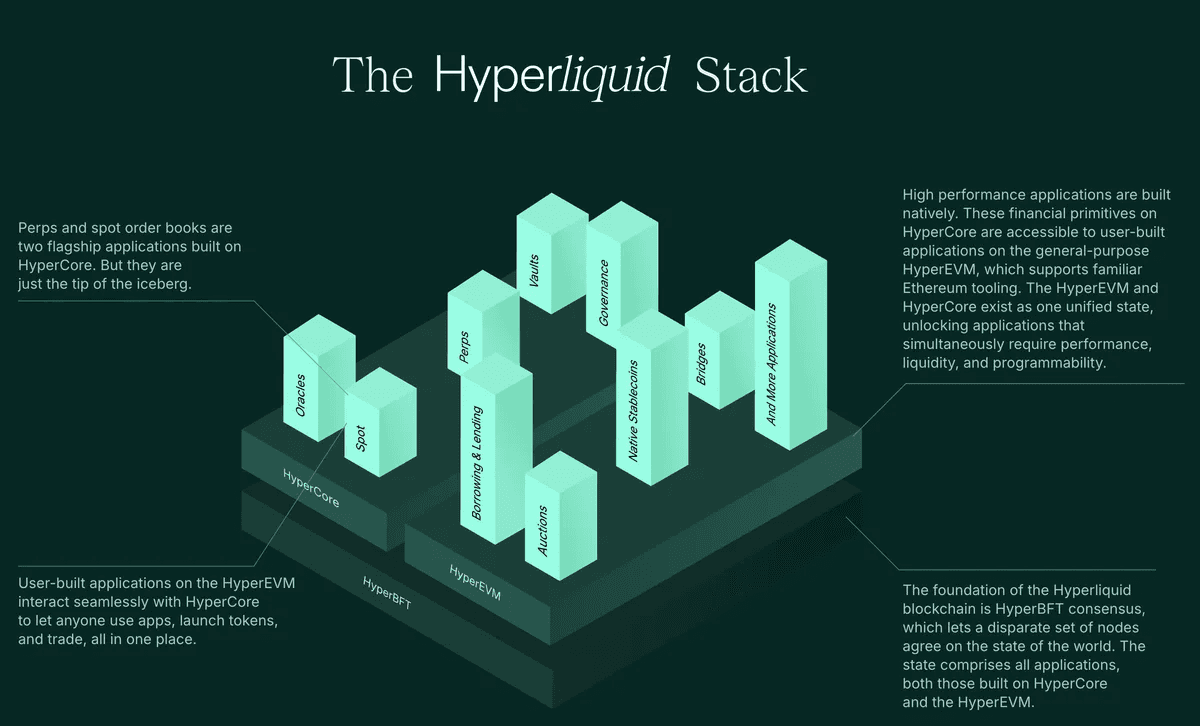
Hyperliquid runs two execution environments that share the same consensus (HyperBFT): HyperCore and HyperEVM.
HyperCore (L1) handles the on-chain order book, matching engine, perpetuals, and exchange logic with sub-second finality. It enables high-frequency trading operations entirely on-chain, without requiring a smart contract for each trade.
HyperEVM, by contrast, is an EVM-compatible environment for general-purpose smart contracts and DeFi integrations. Developers can deploy Solidity contracts and use standard Ethereum tooling. HyperEVM leverages HYPE as its native utility token. Beyond simple gas fees, HYPE anchors the network’s decentralized security model, ensuring that every smart contract execution on the EVM layer remains computationally verified and sybil-resistant.
Because these two environments serve fundamentally different workloads, Hyperliquid exposes distinct RPC interfaces for each layer.
HyperEVM provides the familiar JSON-RPC interface for Ethereum-style calls such as eth_call and eth_sendRawTransaction.
HyperCore, however, exposes specialized API methods for exchanging data and trading actions, including REST endpoints and WebSocket feeds for real-time data updates.
This architectural split directly influences how builders design Hyperliquid integration.
Hyperliquid RPC: Data Streams vs API
Hyperliquid’s RPC infrastructure supports both traditional request-response calls and streaming models. Understanding the distinction is essential for high-performance systems. Pull-based models rely on JSON-RPC over HTTP. Clients send requests and receive responses. This works well for:
Balance checks
Transaction submission
Occasional state queries
Push-based models rely on WebSocket streaming. Clients subscribe once and receive real-time data continuously. Below is a structured comparison:
Feature | JSON-RPC API (Pull) | WebSocket Stream (Push) | gRPC (Binary Stream) |
|---|---|---|---|
Communication Model | Request-response | Persistent connection | Bidirectional Streaming |
Use Case | Account queries | Order book updates | HFT / Institutional Data |
Latency | Moderate | Low | Sub- 10ms |
Throughput | Limited by polling | Continuous | Max ztsd binary compression |
Ideal For | Backend scripts | Trading engines | High-Frequency Trading |
Rate Limits | Enforced per request | Enforced per connection | Tiered by Provider |
Polling introduces delay and inefficiency. Streaming maintains a synchronized state without repetitive requests.
Production builders often combine both: JSON-RPC for deterministic transactional logic and WebSocket streams for market data.
Where does gRPC fit?
Integrate gRPC for high-volume environments where text-based JSON is too heavy. By using a binary format, gRPC minimizes data overhead and CPU usage, allowing your trading engine to process massive order-book updates with significantly less lag than traditional HTTP-based calls.
Real-Time Streams: Mastering the Hyperliquid WebSocket
Because HyperCore powers high-frequency on-chain order books, streaming becomes foundational rather than supplementary.
Through WebSocket connections, clients establish a persistent channel. Once connected, the server pushes updates automatically as events occur.
Typical subscriptions include:
Order book depth updates
Trade executions
Position changes
Funding updates
During volatile periods, streams can produce high message volumes, thereby making throughput management critical.
At scale, this influences how data is received while maintaining state integrity under pressure. To maintain high uptime, production systems should automate state resynchronization after a disconnect. Implementing exponential backoff and message buffering prevents your client from being overwhelmed by data bursts when the connection restores.
Why HypeRPC is the Preferred Private Gateway for Data
As integration complexity increases, infrastructure variability becomes the limiting factor. Public endpoints are shared infrastructure. During peak demand, congestion increases Latency and triggers strict Rate limits.
Even well-architected systems degrade if the underlying RPC provider introduces unpredictability.
HypeRPC functions as a private gateway optimized for Hyperliquid workloads. It isolates traffic and provides predictable infrastructure performance.
HypeRPC eliminates the 'noisy neighbor' effect of public endpoints. By providing dedicated bandwidth allocation and stabilized rate limits, HypeRPC ensures your trading logic executes during high-volatility events when public infrastructure typically throttles users.
HIP-4 and Beyond: Data Needs for Outcome Trading
With HIP-4 Outcome Markets, the performance bar rises further.
Outcome trading introduces event-driven dynamics that depend on precise timing and continuous state awareness.
As HIP-4 matures, developers must prioritize instantaneous order-update feeds. Because outcome markets involve fixed-range settlements without oracles, your infrastructure is the only source of truth for tracking market-driven event odds in real-time.
With these systems, low latency and sustained throughput become the determining factor on how outcome engines remain competitive.
At this stage, Hyperliquid RPC becomes a synchronization mechanism between streaming data and transactional execution.
Scaling Your Integration with a Private Hyperliquid Data API
As Hyperliquid evolves, infrastructure discipline becomes a differentiator. Although development environments tolerate throttling, production systems do not.
Once user load increases and strategies become more sophisticated, scaling Hyperliquid integration becomes essential, and this requires:
Monitoring RPC error codes
Tracking response times
Proactive management of Rate limits
Implementing failover nodes
Horizontal scaling of client services
A private gateway reduces exposure to unpredictable throttling. Combined with observability tooling, it enables sustainable growth.
At scale, RPC infrastructure is a core architectural component.
Final Thoughts on RPCs
Hyperliquid RPCs govern how applications query state, submit transactions, and consume real-time market data across HyperCore and HyperEVM. Leveraging private gateways such as HypeRPC aligns infrastructure reliability with production demands.
Developers who understand Hyperliquid RPC at the protocol level build systems that scale predictably, execute reliably, and remain competitive as the network evolves.
FAQs
1. What is Hyperliquid RPC used for?
Hyperliquid RPC enables applications to query network state, submit transactions, retrieve order book data, and stream real-time updates for trading logic.
2. Should developers use WebSocket or JSON-RPC?
WebSockets are well-suited for real-time streaming, such as order book updates. JSON-RPC works well for transactional requests and state queries.
3. What is the difference between public RPC and HypeRPC?
Public RPC endpoints share bandwidth and enforce strict Rate limits. HypeRPC offers a private gateway with predictable Latency and higher Throughput capacity.
4. How does RPC affect trading latency?
RPC infrastructure determines how quickly orders are submitted and confirmed. Lower Latency reduces slippage and improves execution quality.
5. Is RPC required for HIP-4 Outcome Markets?
Yes. Outcome market integrations rely on streaming updates and rapid transaction submission, both enabled through a powerful Hyperliquid RPC architecture.