Key Takeaways
On March 18, 2026, the S&P 500® was officially licensed to Trade[XYZ], replacing risky synthetic mirrors with sanctioned, institutional-quality data.
During the March 9–10 Iran conflict, Hyperliquid processed $1.32B in oil volume while traditional CME markets were closed, proving the necessity of 24/7 on-chain rails.
HyperCore delivers 70ms finality and 200,000 TPS, providing the native price-time priority matching required for professional-grade equity trading.
High-stakes RWA trading requires bypassing public internet congestion; HypeRPC delivers sub-500µs response times via dedicated nodes and Direct Sentry Peering.
Real-World Assets on Hyperliquid blockchain have moved from a basic experiment to an institutional compulsion. On March 18, 2026, S&P Dow Jones Indices officially licensed the S&P 500® to Trade[XYZ], enabling the first and only sanctioned perpetual derivative contract for the world’s most iconic benchmark on a decentralized network.
This milestone was catalyzed by a period of extreme traditional market failure. During the weekend of March 9–10, 2026, as geopolitical tensions in the Middle East escalated, traditional energy markets like the CME were closed. In the interim, Hyperliquid’s oil perpetuals (CL-USDC) surged, processing $1.32 billion in 24-hour volume—briefly overtaking Ethereum as the platform's second most liquid asset.

This milestone was catalyzed by a period of extreme traditional market failure. During the weekend of March 9–10, 2026, as geopolitical tensions in the Middle East escalated, traditional energy markets like the CME were closed. In the interim, Hyperliquid’s oil perpetuals (CL-USDC) surged, processing $1.32 billion in 24-hour volume—briefly overtaking Ethereum as the platform's second most liquid asset.
The Institutional Pivot: From Synthetics to Licensed RWAs
![Labels with names of Trade[XYZ], S&P DJI](https://framerusercontent.com/images/rKiuSp7D8XkuPzULVOeqAdRvzm8.png)
For years, on-chain equity exposure meant synthetic mirrors: products pegged to unofficial oracle price feeds with no IP governance and no data-quality guarantees. That model carried two fatal flaws for institutional adoption: ambiguity around the underlying data and a lack of regulatory clarity on licensing.
The S&P DJI–Trade[XYZ] collaboration broke that pattern.
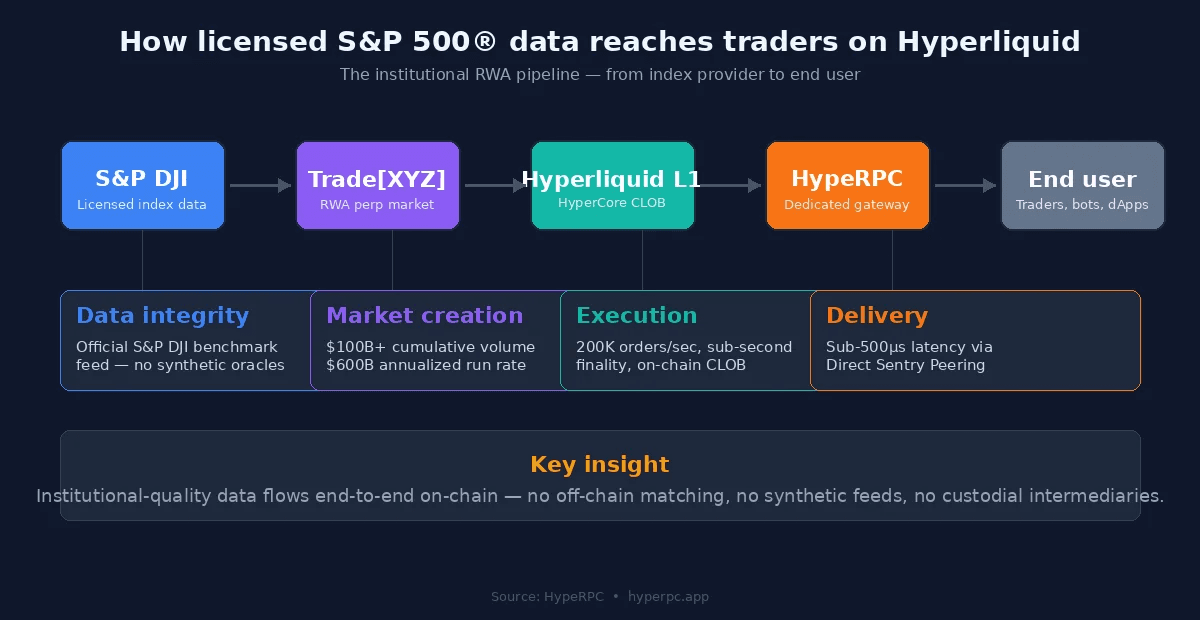
The product uses institutional-quality S&P DJI index data directly, not a third-party approximation. It is the first officially licensed S&P 500 Index perpetual in any market, centralized or decentralized.
Within 24 hours of launch, the contract processed over $100 million in daily volume.
Trade[XYZ] is not a newcomer to this architecture. As the first and largest Real-World Asset (RWA) market on Hyperliquid, XYZ markets have cumulatively exceeded $100 billion in volume since October 2025, with an annualized run rate currently surpassing $600 billion.
That throughput makes it one of the highest-velocity RWA venues in DeFi, and the S&P 500® perpetual is designed to accelerate that trajectory.
Why Hyperliquid Is the Premier Destination for Real-World Assets
The answer lies in HyperCore, Hyperliquid’s native L1 central limit order book (CLOB). Unlike other chains that rely on slow automated market makers (AMMs), HyperCore provides:
Throughput: 200,000 orders per second.
Precision: Sub-second finality with 70ms (0.07 seconds).
Transparency: Price-time priority matching is handled natively on-chain via HyperBFT consensus.
The impact of this architecture was recently noted at JPMorgan’s March 2026 Asia Pacific Macro Conference, where analysts observed that the "commodities supercycle" of 2026 is being led by venues that offer 24/7 access and self-custody—qualities that traditional exchanges simply cannot replicate.
Solving the Latency Bottleneck for 24/7 Global Markets
The 'Weekend Gap' is a structural risk legacy finance has yet to solve. When traditional desks froze during the geopolitical escalation on March 9, 2026, Hyperliquid remained live, with oil perpetuals surging to a record $1.32 billion in 24-hour volume.
However, volume is a liability without the infrastructure to absorb it. During this March peak, public RPC endpoints faced significant degradation. HypeRPC solves this by providing dedicated nodes and Direct Sentry Peering, delivering sub-500µs response times that ensure execution parity even when public infrastructure hit its rate limits.
Infrastructure Requirements for Institutional-Grade RWA Trading
Institutional-grade RWA tokenization on Hyperliquid blockchain demands more than a trading interface. It requires purpose-built infrastructure across three layers.
HyperCore’s on-chain CLOB provides native price-time priority matching. Median transaction latency sits at 0.1 seconds; 99th percentile latency remains below 0.5 seconds. Portfolio margining enables capital-efficient strategies across RWA and crypto positions simultaneously.
HypeRPC’s managed access layer operates as a 1:1 private gateway to Hyperliquid’s native endpoints. Dedicated nodes offer throughput limits significantly higher than public endpoints, with infrastructure deployed exclusively in Japan for the lowest physical latency. WebSocket and REST endpoints support everything from low-latency trading bots to analytics dashboards.
A 99.99% uptime SLA, automatic routing to the fastest cluster across EU and JP regions, and validator-peered connections ensure production-grade stability. For market makers and institutions with extreme throughput requirements, dedicated RPC nodes provide fully isolated resources and elevated rate limits.
The Future of On-Chain Benchmarks: Beyond the S&P 500®
The S&P 500® perpetual is the starting point, not the ceiling. While the HIP-3 framework has already birthed thriving markets for gold and WTI crude, the ecosystem is now preparing for the HIP-4 upgrade (Outcome Trading). Announced as the next major protocol evolution, HIP-4 will introduce fully collateralized 'Outcome Assets'—enabling binary options and prediction markets directly on HyperCore. This expansion positions Hyperliquid as the foundational venue for 24/7 global capital, moving the platform beyond perpetuals into a comprehensive financial operating system.
For builders and institutions evaluating this ecosystem, the takeaway is structural: Real-World Assets on Hyperliquid are no longer a theoretical DeFi narrative. They are the next protocol evolution currently driving the ecosystem's momentum. The firms that invest in institutional DeFi infrastructure, from HypeRPC dedicated RPC nodes to optimized data pipelines, will define the next generation of 24/7 capital markets participation.
FAQs
1. Why are RWAs moving to Hyperliquid instead of other L1s?
Hyperliquid operates a fully on-chain central limit order book (HyperCore) with native price-time priority matching, a feature no other L1 provides at 200,000 orders per second. Combined with sub-second finality and portfolio margining, it delivers the execution quality institutional RWA products require. Most competing L1s rely on AMM-based pricing or off-chain order books, neither of which meets the data-integrity and speed standards demanded by licensed index products.
2. What is the benefit of a licensed RWA perpetual?
A licensed perpetual contract uses official index data from the benchmark owner—in this case, S&P Dow Jones Indices. That eliminates reliance on unofficial oracle feeds, ensures data accuracy during volatile sessions, and provides the institutional trust layer required for regulated participants and large allocators. Unlicensed synthetic products carry data-quality risk that licensed alternatives remove by design.
3. How does HypeRPC support RWA developers?
HypeRPC provides dedicated throughput and 1:1 private gateways, eliminating the performance variability of shared public endpoints. For RWA developers, this means consistent latency during high-volatility events (when shared infrastructure degrades), higher rate limits for data-intensive analytics, and validator-peered connections with sub-500µs response times. It is the infrastructure layer that transforms Hyperliquid’s raw performance into production-grade reliability for institutional applications.