
How dotHYPE Used HypeRPC for a Smooth HyperEVM Whitelist Reservation Launch
How dotHYPE Used HypeRPC for a Smooth HyperEVM Whitelist Reservation Launch
Client
dotHYPE
dotHYPE
Date
Jan 14, 2026
Jan 14, 2026
This case study examines how dotHYPE executed a fully on-chain whitelist reservation on HyperEVM during one of the most trust-sensitive moments of the product launch. Whitelist opens concentrated real user demand into a narrow window, where infrastructure instability quickly turns into confusion, support burden, and loss of credibility. HypeRPC supported both the read and write paths during this peak concurrency period, when the RPC layer directly shaped the user experience.


Build faster with the same infrastructure.
99.99% uptime
Ultra-low latency
Enterprise-grade security
Build faster with the same infrastructure.
99.99% uptime
Ultra-low latency
Enterprise-grade security
The whitelist phase was designed for a large but intentionally constrained audience. Approximately 25,000 wallets were allowlisted, spanning protocol partners, ecosystem builders, early Hyperliquid users, and long-standing community contributors. The goal was to prioritize alignment and legitimacy while still operating under real-world load conditions that could not rely on off-chain shortcuts or manual gating.
Where HypeRPC Sat in the Stack and What It Powered
dotHYPE used HypeRPC as its primary RPC provider for all read and write interactions during the whitelist reserve flow. During the launch, dotHYPE ran high-volume concurrent eth_call requests for Merkle proof verification, balance checks, and signature validation, alongside state-changing reserve transactions. They also used HypeRPC across three concrete paths:
• Frontend read calls for eligibility checks, including Merkle proof validation and reservation state.
• Transaction simulation and submission for reservation transactions, in both test and production.
• Confirmation polling and receipt finality during peak traffic.
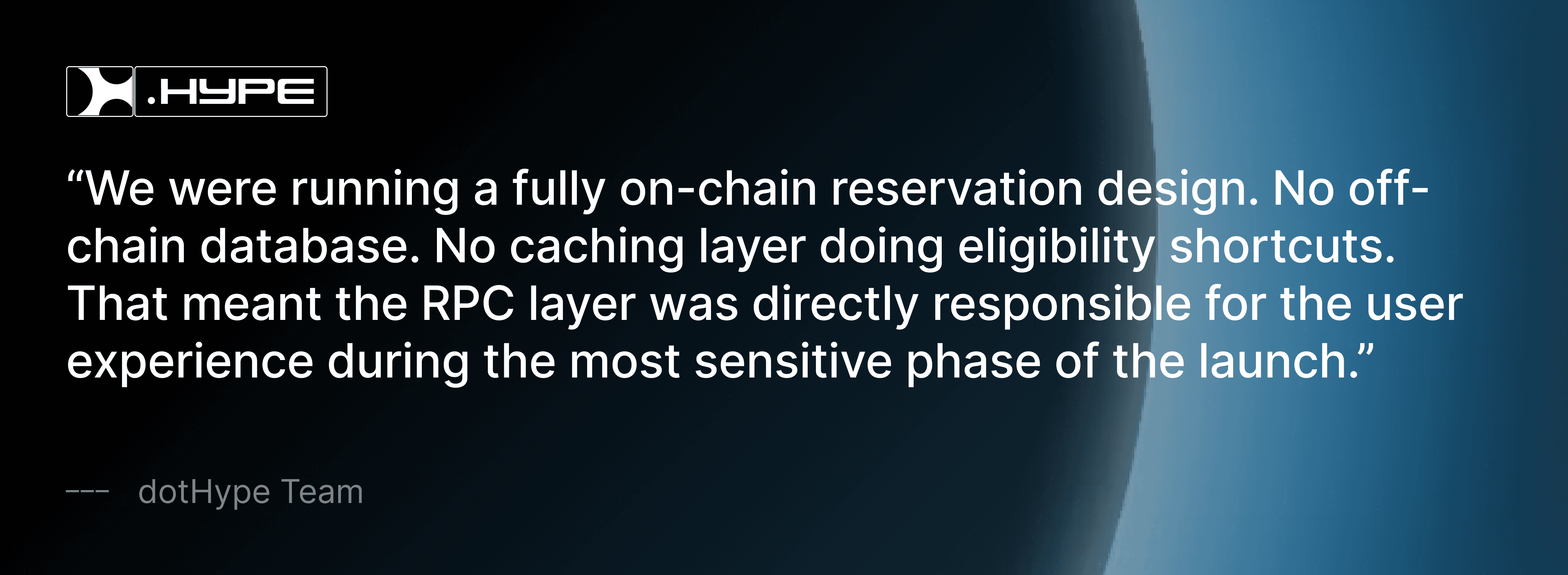
dotHYPE described HypeRPC as the backbone between their frontend and the contracts during the highest concurrency moment of the product.
What dotHYPE Saw During Day One
dotHYPE chose this architecture to avoid off-chain fallbacks and keep the reservation logic on-chain. They did not use off-chain queues, centralised APIs, or manual gating to protect infrastructure. They wanted the contracts to do the work they were designed to do, even with a large whitelist and real user demand.
During the day one reservation window, dotHYPE reported no visible outages, no cascading failures, and no need to throttle or gate users artificially. They also described three outcomes from the reservation stage.
Fast, deterministic eligibility checks
dotHYPE said users confirmed whitelist status without lag or ambiguity, even during heavy traffic windows. They also said they saw no issues during the whitelist check or during the launch of the reservation stage.
Clean reservation settlement
dotHYPE said reservations settled cleanly, with very few dropped transactions or retries relative to the size of the whitelist. They connected that outcome to reduced user confusion and lower support load.
Predictable confirmations and clear feedback
dotHYPE said confirmations stayed predictable. Users received clear success or failure feedback without long-pending states, which they framed as critical for establishing trust during a reservation event.

dotHYPE also noted that Hyperliquid users called it one of the smoothest launches they had seen in the ecosystem at the time. They tied that perception to trust: once users see confusion or distrust during launch conditions, recovery becomes difficult.
Build faster with the same infrastructure.
99.99% uptime
Ultra-low latency
Enterprise-grade security
Build faster with the same infrastructure.
99.99% uptime
Ultra-low latency
Enterprise-grade security
Related case studies

How RedStone Uses HypeRPC for Oracle Data on Hyperliquid

See how innovators use HypeRPC to eliminate latency, improve reliability, and scale with confidence across Web3.

How HypeRPC Delivered Scalable Infrastructure for HLH Builders on Hyperliquid

See how innovators use HypeRPC to eliminate latency, improve reliability, and scale with confidence across Web3.